
Most people development fails at the foundation. We measure it first.

We measure the behavioural foundation that decides whether people development takes root. Then we build from what we find. Grounded in a Harvard-developed taxonomy, field-tested across nine years of practice in Pakistan.

Book a conversation
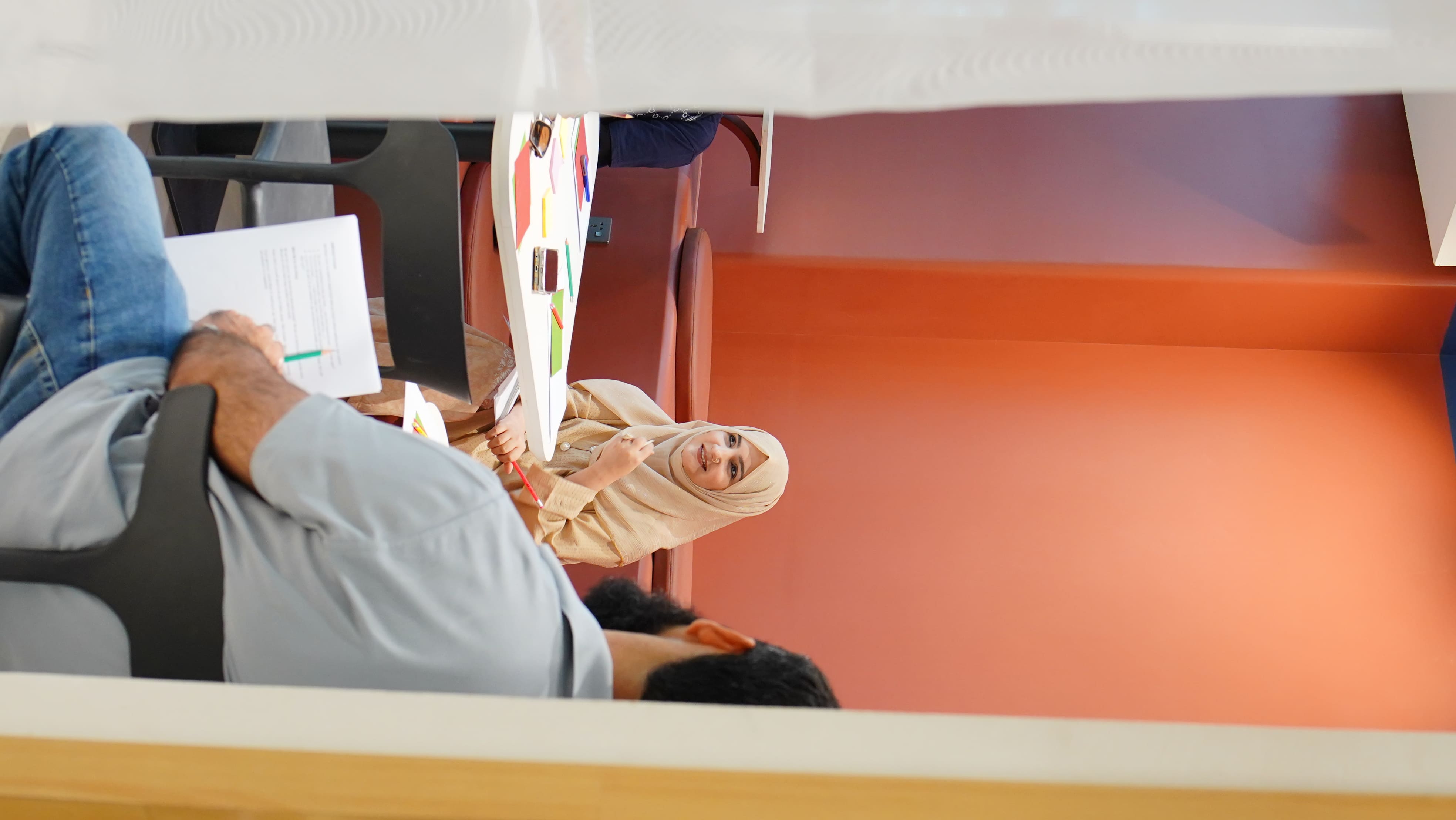
Sarah Khan mid-session with a team
The problem

The biggest waste in L&D is the training that never changes behaviour.

Pakistani organisations spend heavily on training every year. A single two-day programme runs between PKR 180,000 and 250,000 per person. For a mid-size company, that reaches several million rupees a year on one programme alone. Even then, there is rarely a way to know whether behaviour actually changed.

The problem is seldom the trainer or the content. It is the sequence. Behaviour change depends on a foundational layer that decides whether any development takes root, and traditional L&D skips it, because the tools to find it did not exist. We built that tool.

25%
of employees say their company’s training meaningfully improves performanceMcKinsey, 2024
8–10%
of what’s taught is retained from traditional one-off trainingTraining-transfer research
0
nationally norm-referenced workforce behavioural datasets exist in PakistanSKA analysis
The approach

Three layers, read in sequence.

Behaviour is layered. Skills sit on top. Beneath them are the relationships that carry them, and beneath those, the foundation of purpose and ownership. When that foundation is strong, development at the upper layers is far more likely to take root and last.

LAYER 1

Purpose

The foundation. Values in practice, clarity of direction, and the ownership that decides whether people act or wait to be told.

LAYER 2

People

The relational layer. How the team regulates disagreement, collaborates, and seeks and offers support when it is needed.

LAYER 3

Performance

The execution layer. Focus, planning, adaptability, and how the team responds when the original approach stops working.

Read how the framework works →

Operational, not idea-stage

Already building, earning, and recognised.

Harvard EASEL Lab
Anchor Organisation Lead, PSS-SEL Toolbox Phase II
gLOCAL 2026
Panelist, gLOCAL Evaluation Week 2026 · When SEL Travels · Organised by Dream a Dream India · Hosted by Global Evaluation Initiative
Standard Chartered WomenInTech
Cohort 8, selected 1 of 10 nationally
Nine years of practice
Field-tested with 300+ adults, contextualised for Pakistan

Find out what your development strategy is built on.

One conversation. We will show you where to look.

Book a conversation
The Approach

The Translation Gap, and how to close it.

The distance between what an organisation wants from its people and what actually shows up in behaviour on a working day. Most interventions treat the symptom. We address the source.

Why training fails

The failure is rarely the content. It is the sequence.

Standard L&D installs visible execution skills on teams whose foundation has never been examined. The skills often produce a strong first month and then fade, because the layer that would have sustained them was never addressed. This pattern, repeated across organisations and budgets, is the Translation Gap.

The work happens in the room, not on the slide.

We watch behaviour where it actually lives, in how a team talks, decides, and handles pressure together. That is where the foundation shows itself, long before any framework is drawn on a wall.

A candid team conversation in session
A live session. The conversation most teams never have.
The framework

Three layers, read foundation-first.

LAYER 1 · THE FOUNDATION

Purpose

Values in practice, clarity of direction, and the internal ownership that determines whether people act with intent or wait to be told, especially under pressure and when no one is watching. When this layer is strong, interventions aimed at the layers above it are far more likely to hold.

LAYER 2 · THE RELATIONAL LAYER

People

How the team regulates disagreement, collaborates, and seeks and offers support when it is needed. The relational layer carries purpose into daily interaction. When the foundation is weak, this layer tends to absorb the strain.

LAYER 3 · THE OUTPUT

Performance

Focus, planning, adaptability, and how the team responds when the original approach stops working. The visible layer, and the one most organisations try to fix directly. Work here lasts longer when the two layers beneath it are stable.

The method

Diagnose first. Design precisely. Demonstrate change.

01

Diagnose

A short behavioural assessment locates which layer the gap sits in, and produces a baseline report that names the findings, their drivers, and their cost, with a sequenced recommendation.

02

Design

Structured behavioural development addresses the layers in the right order, starting at the foundation rather than the symptom. Intervention follows evidence rather than assumption.

03

Demonstrate

Re-assessment demonstrates whether behaviour actually changed, closing the loop that conventional L&D leaves open and turning a one-time programme into a measurable trajectory.

See the framework applied to one of your teams.

Book a conversation
The Diagnostic

Thrive by Design

A behavioural baseline for your team. Fifteen minutes to complete, a structured report in your hands within working days.

What it is

A dual-lens behavioural screen, completed by the team lead and the team itself.

Both the department or L&D head and the team members complete a short behavioural assessment, each from their own vantage point. The instrument brings the two perspectives together, scoring the team across Purpose, People, and Performance, and locating not just where the gap sits, but where the leader’s view and the team’s lived experience diverge.

It is grounded in a taxonomy developed at Harvard’s EASEL Lab and adapted for Pakistani professional settings, so the patterns it surfaces are the ones that actually show up here.

How it works

Three steps. A few working days. One clear baseline.

01

Complete the assessment

The team lead and each team member complete a short assessment, around fifteen minutes each, from their own perspective. Access is issued per engagement.

02

We review and write the report

Every report is reviewed by Sarah Khan Associates and grounded in your team’s specific responses, never generic. Delivered within three to five working days.

03

You receive a behavioural baseline

A clear report: where the team scores on each layer, where leader and team perspectives align or diverge, what each finding is costing, and a sequenced recommendation you can act on.

What you receive

A baseline you can build decisions on.

The report shows each layer scored against a clear threshold, names three connected findings and the cost of each, and gives a concrete next step in the right order. It tells you, plainly, whether your next training investment will land or revert, and where to spend first.

A team reviewing its baseline together
A team reads its baseline together, where knowing becomes doing.

A baseline gives the team a shared place to start.

The value is not the score. It is the conversation the score makes possible. A team looking at the same evidence, naming the same gap, and agreeing where to begin.

Run the diagnostic on one team.

Ready to see where your team stands? Request access to begin. The diagnostic takes fifteen minutes to complete, and your report follows within three to five working days.

Request access Already have a code? Take the assessment →

Individual responses stay confidential. Reports share aggregate, team-level insights only. Never individual scores.

The Research

Nine years, one question, and where it led.

The body of work behind the diagnostic, and the question that started all of it.

Where it begins

It started with one question.

Why do organisations spend so much developing their people, and see so little actually change?

We have spent nine years sitting with that question. In rooms, with real people, watching what happens when the pressure is on, when relationships get difficult, when values get tested. And the same thing kept showing up. The problem was never that people did not know what to do. The problem was the distance between what they knew and what they actually did when it mattered.

We call that distance the Translation Gap. Closing it became our life’s work.

The research behind it

That work took us to Harvard.

SKA is the Anchor Organisation Lead for the EASEL Lab at Harvard University, one of the world’s leading centres for social and emotional learning research.

Our work there asks a hard question. When a competency framework built in one part of the world is brought into another, what survives the journey, and what disappears?

The answer we keep arriving at is uncomfortable. The things that matter most are often the first to get lost. The local meaning, the cultural weight, the way a behaviour actually shows up in a Pakistani office rather than an American one. Most tools never notice what went missing. Ours is built to find it.

With Dr. Stephanie Jones at the Harvard EASEL Lab
With Dr. Stephanie Jones, Director EASEL Lab · Harvard Graduate School of Education · November 2025
Consultative session at the Sindh Education Policy Commission
Consultative session on SEL and workforce development · Sindh Education Policy Commission · Karachi
The work reaches further

It did not stay in the research room.

The deeper the work went, the further it travelled. What began as a question about people development became a conversation about the workforce. And then a conversation about policy.

We were invited to sit with the Sindh Education Policy Commission to discuss the state of social and emotional learning in Sindh, and what it means for the people who will carry this economy forward.

The same thinking that helps one team in one office also speaks to how a province prepares its people. That is the reach of this work when it is done properly.

Made usable

And then we turned it into something you can use.

The Thrive by Design Diagnostic did not come from a textbook. It came from nine years of watching how Pakistani professionals actually behave at work.

Every question in it, every layer, every line of the report, reflects something we saw with our own eyes in the field. Nothing was imported from somewhere else and relabelled for this market. That is what makes it different. And that is what makes it work here, where so many borrowed tools do not.

Where it is going

This is only the beginning.

Every diagnostic we run feeds something larger.

We are building Pakistan’s first National Workforce Behavioural Intelligence Index. A benchmark that tells an organisation not just how its team is doing, but how its team compares to the wider Pakistani workforce.

Right now, that benchmark does not exist. We are building it, one organisation at a time. And every organisation that works with us becomes part of the first real picture of how Pakistani teams actually function.

Become part of the evidence base.

Start with a conversation. We will show you where to look.

Book a conversation
About

Building the Global South’s behavioural evidence base.

Global frameworks are built on Western data, then travel South. Sarah Khan Associates is reversing that direction, using social-emotional learning as a lever for human capital development.

The firm
Sarah Khan, Founder Sarah Khan · Founder

A behavioural intelligence and research-translation firm.

Sarah Khan Associates works at the intersection of social-emotional learning research and applied human capital development. We translate rigorous behavioural science into instruments and interventions that work in real organisations, and we generate the data that the field in this region has never had.

Our founder is a PhD scholar at the University of Karachi and serves as Anchor Organisation Lead for the PSS-SEL Toolbox Phase II at Harvard’s EASEL Lab. The frameworks behind our work are grounded in the ExploreSEL taxonomy developed at Harvard, adapted through a commissioned research partnership, nine years of field implementation in Pakistan, and ongoing doctoral research.

We treat social-emotional learning as core infrastructure for workforce development, not a soft add-on. The capacities the World Economic Forum names as defining for the coming decade, resilience, adaptability, collaboration, are foundational behavioural capacities. SEL is how they are built, and measurement is how they are managed.

Leadership

Waqar Rashid · Co-Director

Waqar brings over a decade of corporate experience across leading multinationals, including Philip Morris International, Abu Dawood Group, and Maersk. He leads SKA’s corporate partnerships, translating behavioural science into real organisational adoption, and bridging the gap between what the research shows and what businesses can actually act on.

Contact: waqar@sarahkhan.co

The mission

SEL-based capacity building, measured.

We build the measurement layer beneath people development in the Global South, so that organisations can invest in behaviour the way they invest in anything else they take seriously: with a baseline, a method, and evidence of change.

North Star

Pakistan’s first National Workforce Behavioural Intelligence Index. Norm-referenced. Built from local data. Designed to stand alongside the global benchmarks, rather than borrow from them.

Recognition

Where the work already stands.

Harvard EASEL Lab
Anchor Organisation Lead, PSS-SEL Toolbox Phase II
gLOCAL 2026
Panelist, gLOCAL Evaluation Week 2026 · When SEL Travels · Organised by Dream a Dream India · Hosted by Global Evaluation Initiative
Standard Chartered WomenInTech
Cohort 8, 1 of 10 selected nationally
SECP Incorporated
Sarah Khan Associates (Pvt) Ltd., 2026

Work with us.

For corporate, institutional, or research partnerships.

Book a conversation
Security & Privacy

Protecting Your Information

We are committed to protecting the information you share with us.

When you complete our assessment request form, we collect only business-related, non-sensitive information, such as your company or organization name, your role, business email address, team or department details, and other information relevant to delivering our services.

We use this information solely to deliver our assessment services and to communicate with you about them.

We do not sell, rent, or share your information with third parties for marketing purposes. Access to your information is restricted to authorized personnel at Sarah Khan Associates (SKA) who require it to provide our services.

Your information is transmitted securely using encrypted HTTPS connections and stored on secure cloud infrastructure. Our hosting platform uses infrastructure that maintains internationally recognized security certifications, including ISO 27001 and SOC 2 Type 2, helping ensure that your information is stored securely.

If you have any questions about how your information is handled, please contact us at security@sarahkhan.co

Have more questions?

We are happy to walk you through how your data is handled.

Book a conversation